Widely applied in metallurgy, mining, chemical engineering, building materials, coal, refractory materials, ceramics, and other industries.
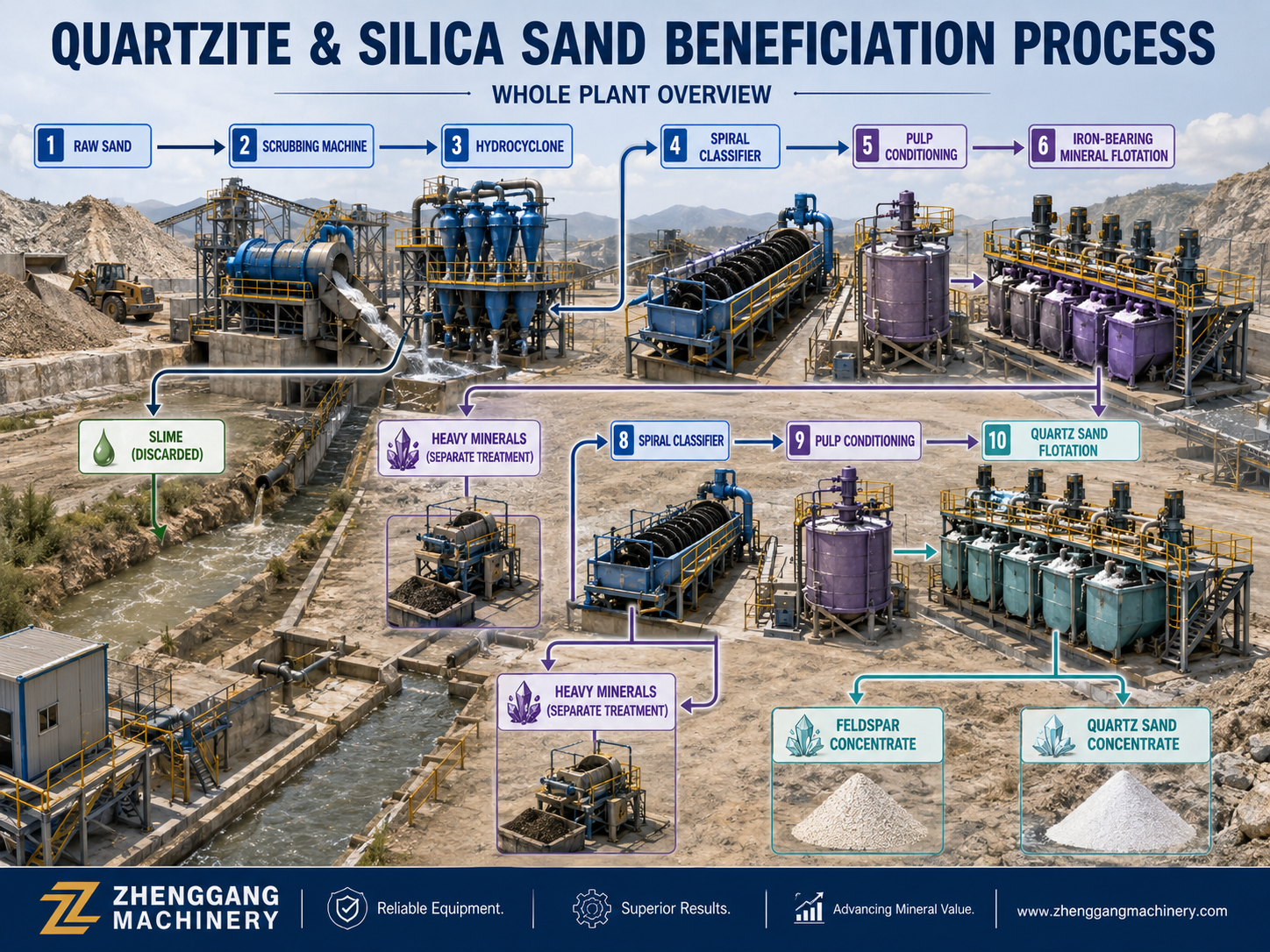
Silica sand purification removes small or trace impurities to produce refined, high-purity, or ultra-high-purity silica sand.
Main purification methods include washing, classification desliming, scrubbing, magnetic separation, flotation, acid leaching, microbial leaching, and other deep purification processes.
Washing and classification desliming remove clay minerals, fine mud, iron-bearing impurities, and aluminum-bearing impurities before deeper purification
Scrubbing removes film iron, clay-bonded impurities, muddy minerals, and unliberated mineral aggregates from the quartz particle surface.
Magnetic separation, flotation, acid leaching, and microbial leaching further remove weak magnetic minerals, mica, feldspar, Fe, Al, Ti, Cr, and trace impurities.
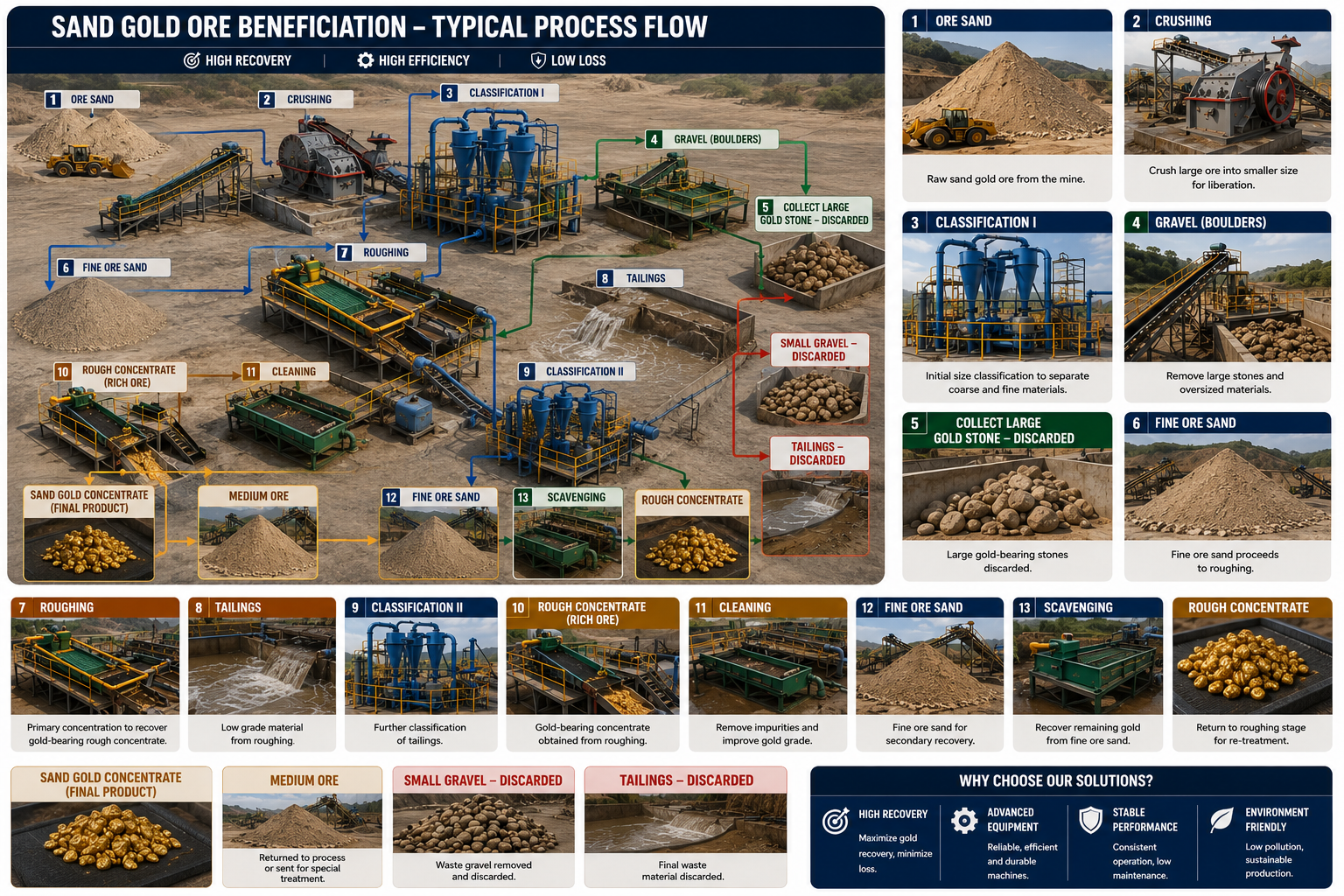
Placer gold beneficiation first uses gravity separation to recover gold and associated heavy minerals.
The process generally includes crushing and screening, desliming, and separation stages.
Screening removes 20–40% waste stones such as gravel and pebbles from placer gold ore.
Desliming removes fine mud below 0.1 mm because it interferes with mechanical separation.
Gold recovery can use sluice separation, jig scavenging, shaking table cleaning, amalgamation, magnetic separation, and electrostatic separation.
Quartz sand purification removes small or trace impurities to produce refined quartz sand or high-purity quartz sand
Main purification methods include washing, classification desliming, scrubbing, magnetic separation, flotation, acid leaching, and microbial leaching.
Washing and desliming remove clay minerals because SiO₂ grade decreases as quartz sand particle size becomes finer.
Scrubbing removes film iron, muddy impurities, and unliberated mineral aggregates from the quartz sand surface.
Magnetic separation, flotation, and acid leaching remove iron, mica, aluminum, titanium, chromium, and other impurity minerals.
Bauxite production line processes alumina-rich bauxite ore for beneficiation and industrial use.
The main process includes washing, preliminary separation, calcination, crushing, grinding, classification, separation, concentration, and filtration.
Bauxite crushing commonly adopts a three-stage closed-circuit crushing process.
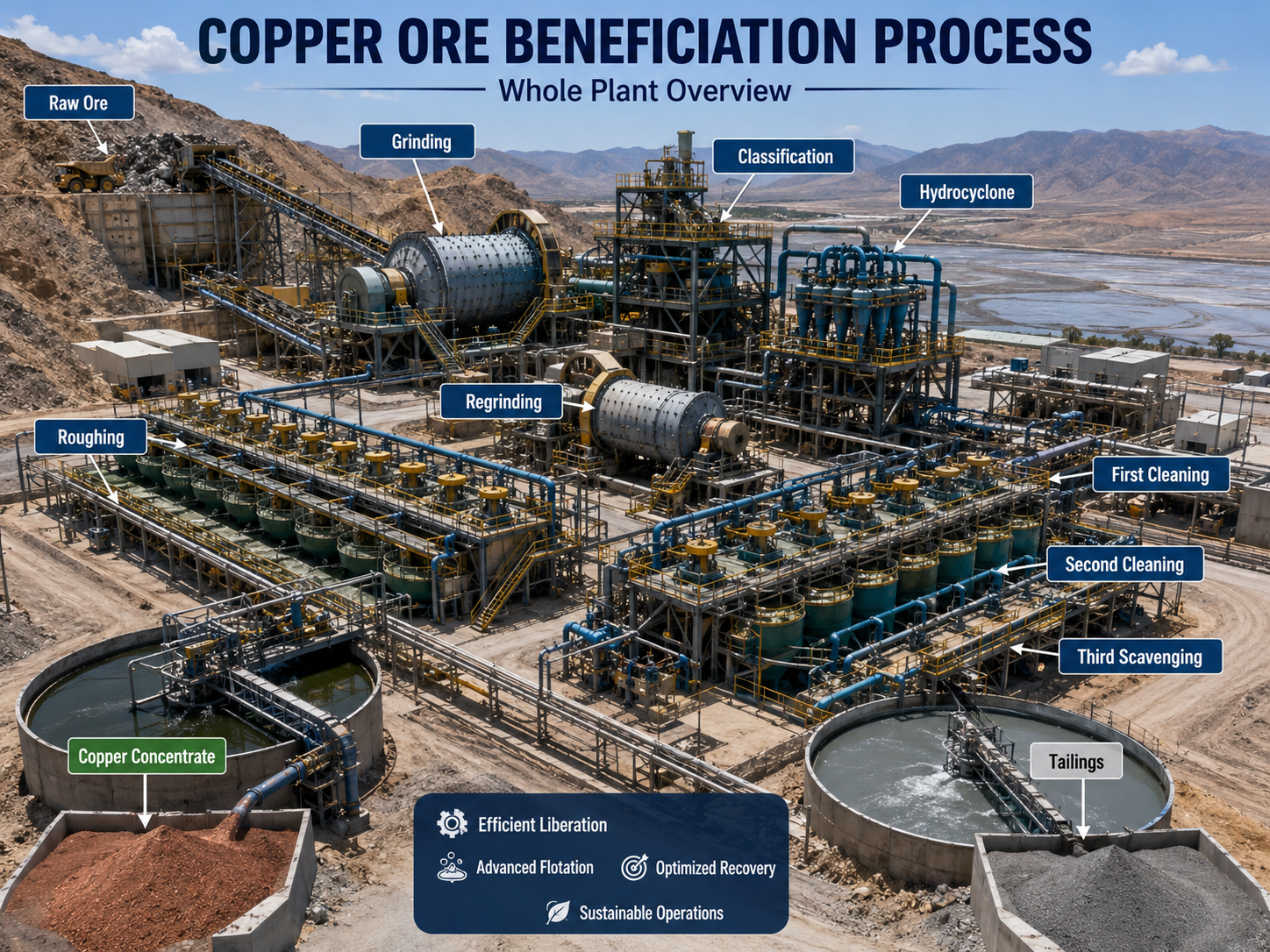
Grinding and classification usually use a grid-type ball mill and hydrocyclone closed-circuit system, with -0.074 mm above 90%.
Flotation commonly adopts one roughing, two cleaning, and two scavenging stages for bauxite separation.
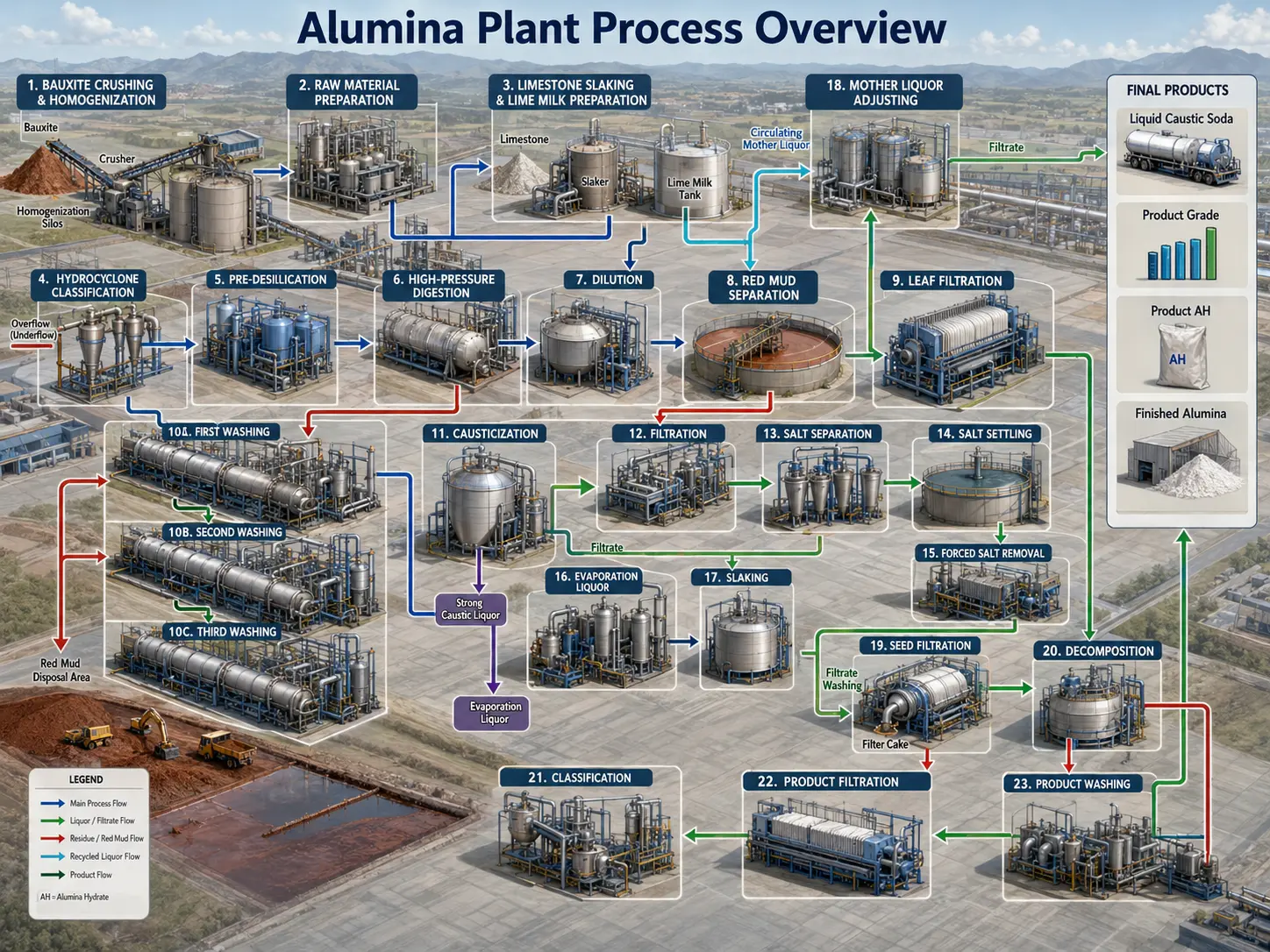
Alumina production line processes bauxite ore into alumina Al₂O₃ for wide industrial applications.
The production relationship is about 4 tons bauxite ore to 2 tons alumina to 1 ton electrolytic aluminum.
Sintering process includes bauxite crushing, stacking, reclaiming, raw meal grinding, slurry preparation, clinker burning, red mud separation, decomposition, filtration, evaporation, and calcination.
Bayer process includes ore supply, raw material preparation, single-tube digestion, settling washing, decomposition system, evaporation system, and calciner.
Combined process includes crushing, material stacking, raw fuel conveying, causticization, raw material grinding, lime kiln, desilication, and compressor system.
Ore-type-based beneficiation for sulfide, oxide, and polymetallic lead-zinc ores.
Sulfide lead-zinc ore is mainly processed by flotation separation.
Oxide lead-zinc ore can use flotation, gravity-flotation, roasting-flotation, or sulfuric-acid-treatment flotation.
Polymetallic lead-zinc ore can use magnetic-flotation, gravity-flotation, or gravity-magnetic-flotation.
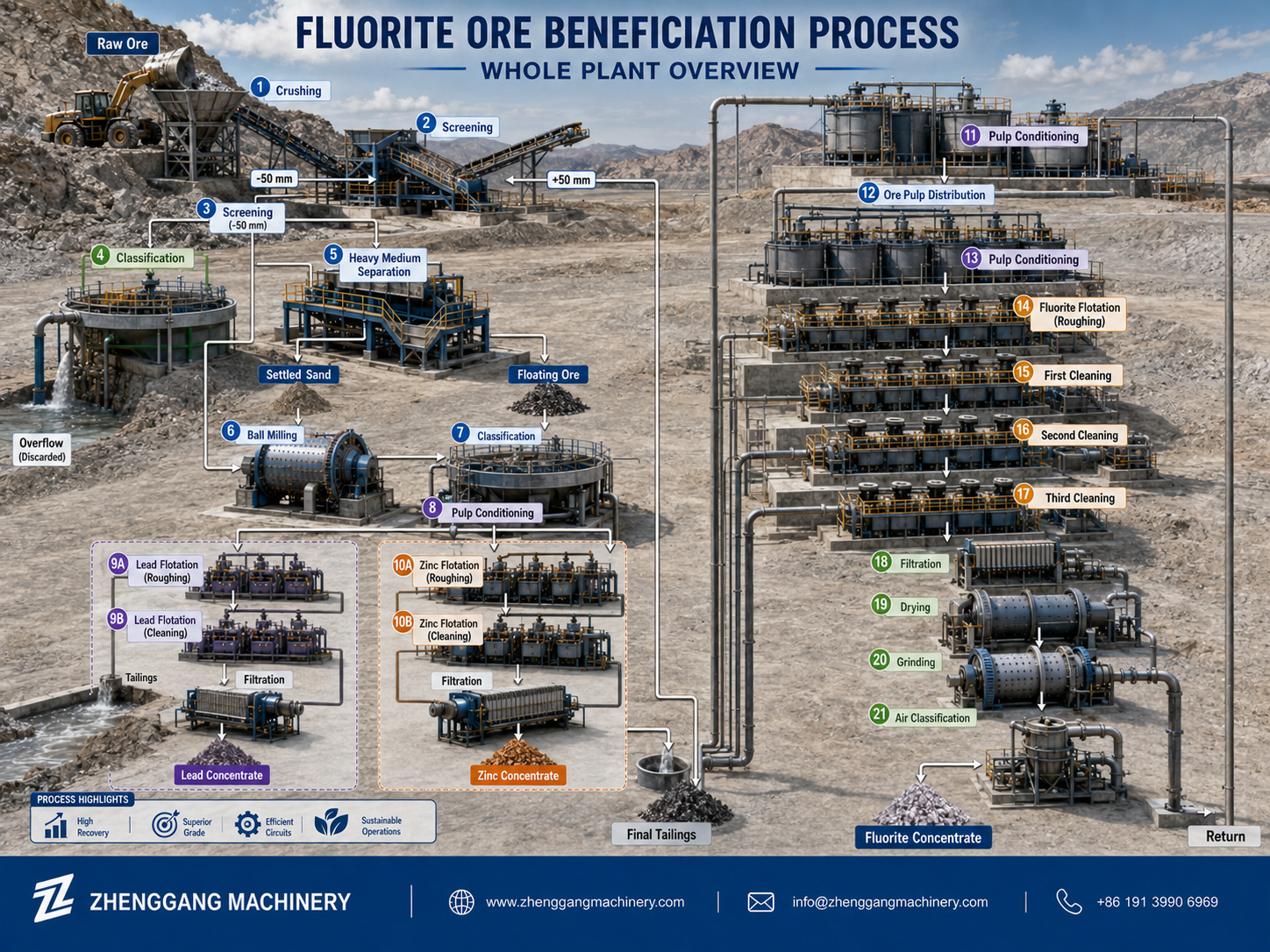
Complete process includes grinding, classification, lead flotation, conditioning, pH control, roughing, cleaning, desliming, and EPC service.
A proven methodology to deliver reliable, efficient, and customized mining solutions.
Detailed ore analysis, site survey, and requirement assessment.
Customized process design with optimized equipment configuration.
Professional installation, commissioning, and on-site training.
Continuous optimization, technical support, and maintenance services.
Our engineering team is ready to design the most suitable mineral processing solution for your specific ore and production goals.