
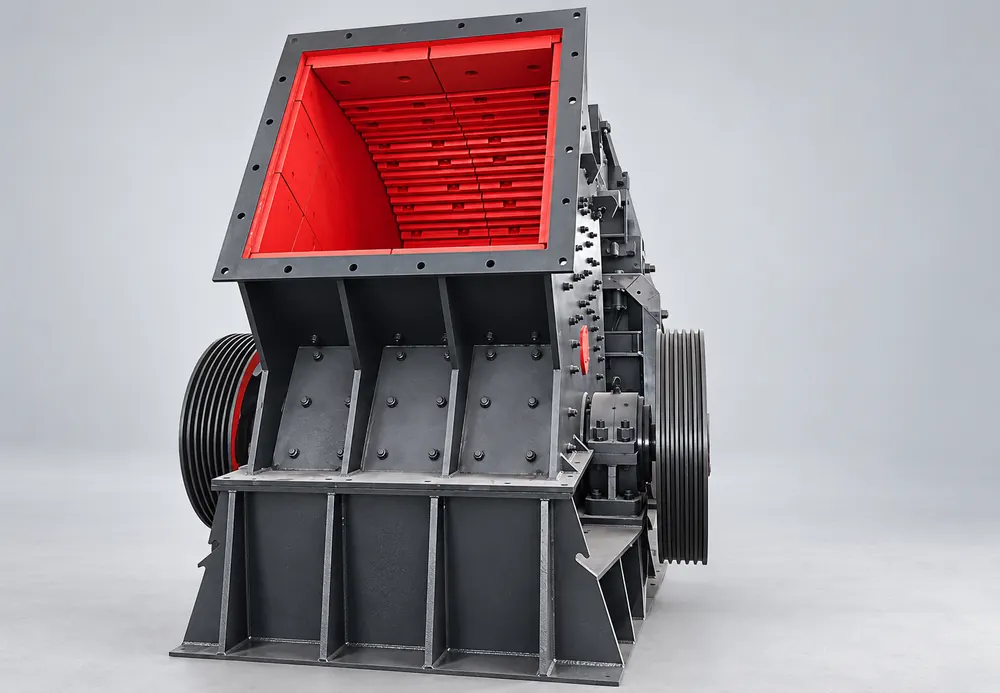
A hammer crusher (also called a hammer mill, or in Spanish-speaking markets a molino de martillos or molino fragmentador) is one of the simplest and most productive machines for reducing medium-hard and brittle materials such as limestone, coal, gypsum and shale. It breaks rock by impact rather than by squeezing, which gives it a high reduction ratio in a compact body. This guide explains how a hammer crusher works, where it performs best, how to build a crushing line around it and what to check before you buy.
How a hammer crusher works
The main working part is a rotor that turns at high speed inside a crushing chamber lined with wear plates. Hammers are hinged on pins around the rotor. When material falls into the chamber, the hammers strike it, throw it against the impact plates and break it along its natural weak planes. Particles that are still too large are struck again and are then sheared and ground against the grate bars (screen bars) at the bottom of the chamber. Only material small enough to pass through the gaps between the grate bars leaves the crusher, so the grate opening is the main way to control product size.
Main components
• Rotor with main shaft, discs and hammer pins
• Hammers (hammer heads) – the main wear parts, usually made of high-manganese steel or alloy steel
• Impact (liner) plates that protect the housing and act as a breaking surface
• Grate bars that set the discharge size
• Housing with feed opening, bearings, motor and V-belt drive
Common types
Hammer crushers are built as single-rotor or double-rotor machines, and as non-reversible or reversible designs (a reversible rotor uses both sides of the hammers before they need turning or replacing). A heavy hammer crusher has a larger feed opening and a heavier rotor, so it can accept bigger lumps and often produce finished aggregate in a single stage, replacing a separate primary and secondary crusher.
Key advantages
• High reduction ratio – in many applications the material reaches its final size in one or two stages.
• Simple structure and small footprint, which keeps installation and foundation costs low.
• Adjustable product size by changing the grate bar gap.
• Well-shaped, cubic particles that suit aggregates, cement raw materials and coal preparation.
• Easy maintenance – the housing opens for quick inspection and hammer replacement.
Typical hammer crushing process
1. Feeding – raw material is delivered from the hopper by a vibrating feeder, which gives an even feed rate and can remove fines before crushing.
2. Primary crushing (if needed) – very large or hard lumps are first reduced by a jaw crusher; a heavy hammer crusher can often skip this step.
3. Hammer crushing – the hammer crusher reduces the material to the size set by the grate bars.
4. Screening – a vibrating screen separates the product into finished sizes; oversize returns to the crusher in a closed circuit.
5. Conveying and stockpiling – belt conveyors connect the machines and carry the products to stockpiles.
Equipment for a hammer crushing line
• ZSW Vibrating Feeder – uniform feeding and pre-screening of fines.
• PE Series Jaw Crusher – primary crushing of large, hard lumps when needed.
• Heavy Hammer Crusher – high-ratio crushing of medium-hard and brittle materials.
• YK Series Circular Vibrating Screen – multi-deck screening into finished sizes.
• TD Belt Conveyor – links the machines and transports the products.
Hammer crushers are widely used in cement plants (limestone, marl, clinker and gypsum), coal preparation and power plants, aggregate and building-materials production, metallurgy and chemical plants. Suitable materials are generally medium-hard and brittle: limestone, coal, coal gangue, gypsum, shale, marl, clinker and similar rocks.
A hammer crusher is not the best choice for very hard, highly abrasive rock such as granite, basalt or quartzite – the hammers wear quickly and the operating cost rises. For these materials a jaw crusher followed by a cone crusher is usually more economical. Very wet or sticky material can also clog the grate bars, so moisture content should be checked before choosing the machine.

Wear parts, maintenance and energy use
Hammer life depends on the hardness and abrasiveness of the material and on the feed size. To keep the crusher efficient and reduce waste:
• Inspect hammers and grate bars regularly, and turn or reposition hammers to use their unworn faces before replacing them.
• Replace hammers in balanced sets so the rotor stays balanced and the bearings are protected.
• Keep the feed steady and remove fines in advance – this lowers energy consumption per ton and reduces overgrinding.
• Enclose the crusher and use dust collection at transfer points to control dust and noise.
A well-maintained crusher uses less power per ton of product and consumes fewer wear parts over its service life.
ZhengGang Machinery manufactures hammer crushers together with feeders, jaw crushers, vibrating screens and belt conveyors, and can supply a single machine or a complete crushing line. The price depends on the model, capacity, feed size, wear-part materials and line configuration. For a quotation, send us your material type, maximum feed size, required product size, capacity (t/h) and moisture content through our contact page.
A hammer crusher offers a high reduction ratio, a simple structure and adjustable output for medium-hard and brittle materials. Choosing the right rotor size, grate opening and hammer material for your material – and pairing the crusher with a suitable feeder, screen and conveyors – gives a reliable, low-cost crushing line.
FAQ
What is the difference between a hammer crusher and a hammer mill?
Both use rotating hammers and work on the same principle. "Hammer crusher" is usually used for coarser crushing of rock and coal, while "hammer mill" often refers to finer size reduction.
How is the output size of a hammer crusher adjusted?
Mainly by changing the gap between the grate bars at the bottom of the crushing chamber. Hammer wear also affects the product size, so worn hammers should be turned or replaced on time.
Can a hammer crusher process granite or basalt?
It can, but hammer wear is high. For hard, abrasive rock a jaw crusher plus cone crusher is usually more economical.
What information is needed to select a model?
Material type and hardness, maximum feed size, required product size, capacity and moisture content.
Planning a crushing line? Contact ZhengGang Machinery for model selection and a quotation.
Contact our sales team today to learn more or schedule a demonstration at your site.
Get a Quote
Tell us about your project. Our engineers will recommend the right equipment and price.